Cabinet Briefing · 1 May 2026

Activate the Bill.
Identity. Companies. Payments.

A sovereignty-preserving digital residency infrastructure — built with the Government of Montserrat, operated by Future Citizen Bureau, designed to deliver non-tax revenue from day one.

Executive Summary

What this is. A sovereignty-preserving digital residency framework. Montserrat issues a digital permit (MID) and a wallet to approved international applicants. The Programme operates under new legislation, with FCB as the contracted operator.

Why now. Montserrat's January 2025 CFATF evaluation placed it outside the FATF grey and black lists — a compliance credential most small jurisdictions cannot claim. Combined with maturing W3C digital identity standards and a growing e-residency market, this is a narrow, bankable window.

What Cabinet is asked to approve on 1 May. Four items: endorsement in principle of the integrated programme scope (MID + IBC + Year-2 stablecoin decision), authorisation to begin Operating Agreement negotiation, designation of the DRO host Ministry, and agreement on a 3-month implementation target. Not the Bill itself — alignment, not legislation.

What will not change. Population. Immigration policy. Citizenship entitlement. Tax residency rules. (The Four Zeros — elaborated in § Sovereign Constant.)

US$750/app
Government Initial Fee
US$1,250/yr
Government Renewal Fee
3 mo
Green Light to Launch
0 capex
Government Investment
The Opportunity

Montserrat's sovereign position is uniquely underwritten.

A British Overseas Territory · English common law · FSC-regulated financial services · a globally sympathetic reconstruction narrative — four conditions top-tier digital residency programmes demand, and that few small jurisdictions combine.

01 · Constitutional Credibility

BOT Trust Premium

A British Overseas Territory with English common law and UK-aligned oversight — constitutional credibility most jurisdictions cannot manufacture, and the foundation for a high-trust digital identity that international applicants and counterparty regulators accept at face value.

Ancient stone archway with a digital blue keystone — constitutional credibility fused with digital statute
02 · Layered Statute

Regulatory Maturity

FSC supervision, AML/CFT Code 2024 alignment, Virtual Asset Business Regulations 2024 — the compliance infrastructure already exists in statute. We are activating it, not building it from scratch.

Stacked metal folios representing layered regulatory statute
03 · Timing

First-Mover Window

The global e-residency market is in its early scaling phase. Moving in 2026 establishes Montserrat's sovereign-backed positioning before the category commoditises — a window that narrows as other small jurisdictions scale similar programmes.

A sleek mechanical clockwork representing luxury precision timing and first-mover window
Category Positioning

Premium tier.
By sovereignty, not by price.

Most digital residency programmes compete on fee level. Montserrat's position lets us compete on constitutional credibility — a defensible moat, not a discount war.

Strategic chessboard matrix and the MDRP card — a defensible positioning, not a price war
MDRP · Montserrat Estonia Palau
Constitutional StatusBritish Overseas TerritoryEU Member StateCompact with US
Legal SystemEnglish Common LawCivil LawMixed
Financial RegulatorFSC · AML/CFT 2024FSABureau of Revenue
PositioningPremium · SovereignVolume · StartupLow-cost crypto
Total Application FeeUS$3,500€100–120US$248
Grants Tax ResidencyNo · by statuteNoNo
Programme ModelModular · Bill §5(1)(b) enables expansionStaticStatic
Strategic Architecture

Digital identity is the foundation.
Each layer strengthens the programme.

The Bill is forward-compatible: it legally enables IBC streamlining, financial services, and wider blockchain ecosystem integration. On 1 May 2026 Cabinet endorses the integrated programme. Year 1 launches with digital identity and the MID Wallet (Layer 1), with IBC streamlining activating in Year 1 Q3 under §5(1)(b) (Layer 2). A Year-2 stablecoin extension (Layer 3) returns to Cabinet as a separate decision. Each layer is self-contained; together they compound.

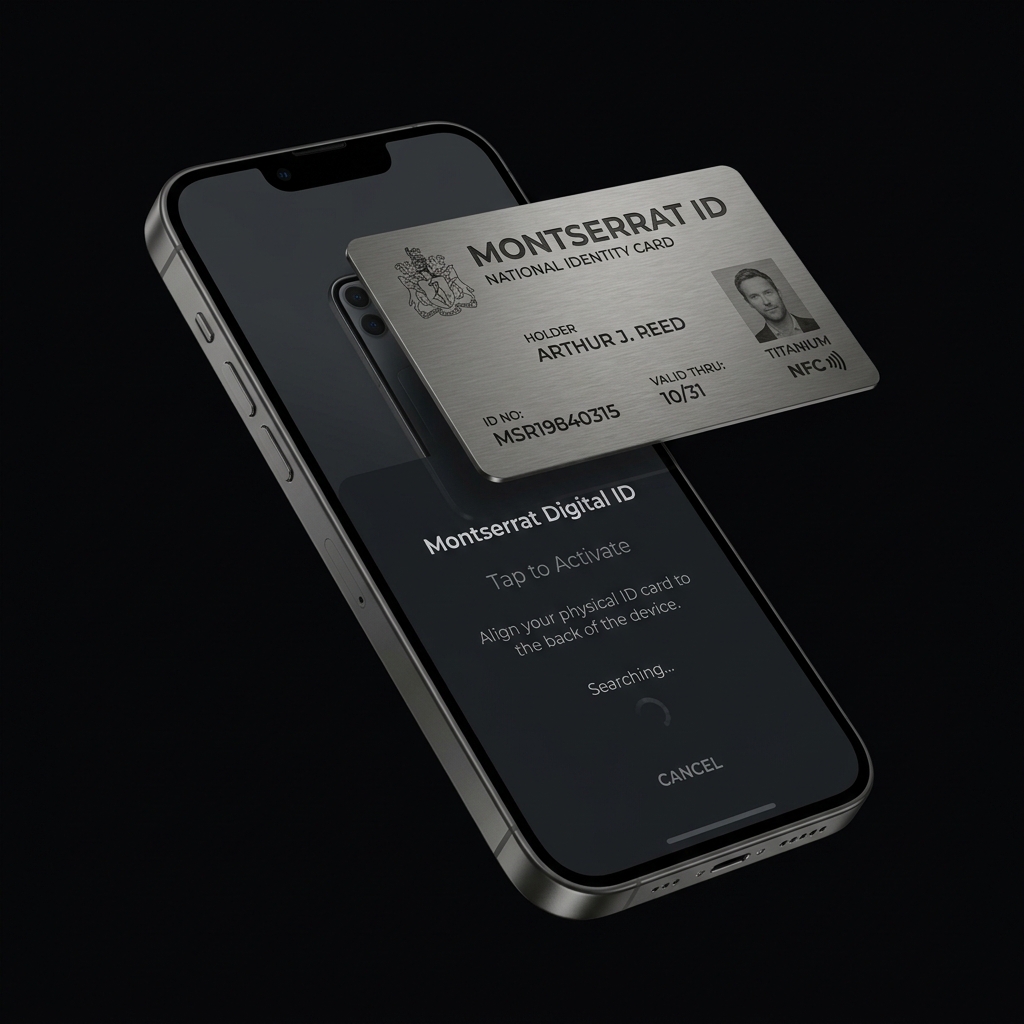
Titanium MDRP ID card hovering over an iPhone displaying the Montserrat Digital ID activation screen — Tap to Activate Year 1 · 2026

Layer 1 — Digital Identity & MID Wallet

MID · MDRP Permit & Digital Carrier

A government-issued digital residency permit paired with the MID Wallet — giving every holder immediate utility, processed through a three-tier compliance gate, generating non-tax revenue from the first applicant.

Launch-day deliverable: a complete applicant experience from biometric onboarding to wallet activation, with the Government's share credited directly to Treasury under the Operating Agreement.

  • Biometric KYC / KYB onboarding
  • Three-tier approval (DRO → FIU → Minister)
  • MID Wallet — digital carrier for programme benefits
  • Annual renewal with re-verification
  • Section 17 blacklist and ongoing monitoring
  • Government-controlled settlement account
Digital Certificate of Incorporation with Montserrat ID card — IBC registration tied to digital residency Year 1 Q3 · Parallel Activation

Layer 2 — IBC Streamlining

Bill §5(1)(b) · Activated by Minister's Regulation

Under §5(1)(b), IBC registration activates in Year 1 Q3 — a parallel workstream alongside MID operations. Every MID holder can form a Montserrat IBC from within the MID wallet environment.

Estonia's precedent is our model: a digital resident can form a company within minutes. That feature is what turns an identity programme into an economic engine — which is why IBC activates alongside MID, not after.

  • Streamlined IBC registration for MID holders
  • Take-up: ~45% of new MID applicants
  • Additional programme revenue from registration fees
  • Cross-border financial services for IBC companies
Secure vault integration render — stablecoin payments rail and treasury settlement infrastructure Year 2 · Separate Decision

Layer 3 — Stablecoin Payments Rail

Bill §5(1)(b) · Year 2 Extension under Minister's Regulation

A regulated XCD-denominated payment token launching Year 2 — turning MID and IBC into a live payments platform. Not fiat, not legal tender, not a CBDC: a fully reserved, redeemable payment instrument under ECCB coordination and FSC supervision.

Adds approximately US$19M to Government non-tax revenue over 10 years, with ~$100M circulating supply and ~$2.5B annual transaction volume by Year 10 — placing Montserrat in the global top-20 of stablecoin jurisdictions. Returns to Cabinet for a separate decision during Year 1.

  • XCD-denominated payment token (1:1 reserved)
  • Serves MID holders + IBC companies (not mass retail)
  • Cross-border receipts, B2B settlement, remittance corridors
  • ECCB consultation + FSC licensing
  • Full detail in Stablecoin & Payments Financial Model
The Sovereign Constant

Four zeros that protect sovereignty completely.

No change to population. No immigration consequence. No grant of citizenship. No transfer of tax residency. The Programme is sovereignty-additive by design.

Titanium vault mechanism — the sovereign parameters are locked by statute
0
Population Impact
0
Immigration Effect
0
Citizenship Grant
0
Tax Residency Shift
Governance & Compliance

Government in charge. FCB executes.

Every applicant clears a three-tier statutory gate. FCB delivers under a structured Operating Agreement with defined performance obligations; Montserrat retains sovereign authority at every level.

Three progressively larger stone archways with a traveling coin — the three-tier approval gate (DRO, FIU, Minister)
Tier 1
DRO Review
Digital Residency Office · §11
Tier 2
FIU Screening
Financial Intelligence Unit
Tier 3
Minister Approval
Final Statutory Authority
Compliance Stack

Layered AML/CFT Architecture

  • KYC
    Biometric and document verification at intake by FCB.
  • FIU
    Independent screening on every application — government authority outside FCB's control.
  • Min
    Minister's final approval — no permit issued without sign-off.
  • Mon
    Annual re-verification at renewal; ongoing monitoring throughout.
  • §17
    Permanent blacklist for rejected or revoked applicants, shared across regulators.
Sovereign Levers

Government retains full oversight authority

  • §14
    Operating Agreement defines scope, obligations, and accountability for both parties.
  • §17
    Bill, Regulations and Blacklist are instruments only Government controls.
  • §8
    No right of entry, abode, employment, or voting — fully BOT-compatible.
  • Aud
    Audit and published revenue reports — financial transparency as a default.
  • Susp
    Minister can suspend issuance at any time; DRO can revoke individual permits.
Full governance architecture
Revenue Model

Zero capex. Real revenue from day one.

The Government's contribution is legislative and administrative; FCB funds the platform, operations, marketing and compliance infrastructure. Three revenue streams launch sequentially — MID (Year 1), IBC (Year 1 Q3 under §5(1)(b)), and a stablecoin payments rail (Year 2 extension). Figures shown below cover MID + IBC; the stablecoin extension is documented separately.

Fee Type · MIDGovernment ShareFCB ShareTotal Per Applicant
Initial Application (3-year term)US$750US$2,750US$3,500
Renewal (5-year term)US$1,250US$1,750US$3,000

Note: Each MID fee includes a US$500 application-processing fee that is a pass-through covering institutional costs (KYC, verification, document handling) and is not part of revenue sharing. The remainder — the 3-year service fee on initial application, or the 5-year service fee on renewal — is the splittable revenue pool. Government's share of that pool rises from 25% on initial applications to 50% on renewals. As the renewal book matures, the programme's revenue mix shifts progressively in Government's favour.

IBC launches in Year 1 Q3 (half-year effective) under Bill §5(1)(b), not Year 2.

Fee Type · IBC (via §5(1)(b))Government Share (70%)FCB Share (30%)Total Per Company
Year 1 · Application + First-Year RegistrationUS$420US$180US$600
Annual RenewalUS$210US$90US$300

How non-tax revenue actually flows

Each applicant clears the three-tier statutory gate before any fee is recognised. On approval, the Government's share is credited directly to a Government-controlled settlement account under the Operating Agreement — no intermediary, no discretionary hold.

A gold coin descending into a classical Treasury building — non-tax revenue flowing to Government
Year 1 · Pilot
US$845K
1,000 MID applicants. IBC activated in Y1 Q3 with 225 first-year registrations.
MID$750K
IBC$95K
Stablecoin
Year 3 · Early Scale
US$2.49M
Stablecoin rail active (Year 2 launch).
MID$1.50M
IBC$500K
Stablecoin$485K
Year 5 · Steady State
US$5.91M
Renewal book building; stablecoin scaling.
MID$3.71M
IBC$885K
Stablecoin$1.31M
Year 10 · Mature
US$15.90M
Annualised. 10-yr cumulative: US$72.5M.
MID$9.17M
IBC$1.89M
Stablecoin$4.84M

Base case assumptions

Government share only · deliberately conservative
MID Year-1 new applicants1,000
MID retention (at each renewal point)78%
MID Y2 growth vs. Y1+50%
MID Y3 → Y10 growth curve+33% → +10%
IBC activationYear 1 Q3
IBC take-up (of new MID applicants)45%
IBC annual renewal retention70%
IBC Gov / FCB split70 / 30
Stablecoin launchYear 2 · separate extension

Formula — Gov annual revenue = (MID new × $750) + (MID renewed × $1,250) + (IBC new × $420) + (IBC renewed × $210) + Stablecoin Gov share (see stablecoin model)
Benchmark — Estonia e-Residency Year 1 (2014): ~10,000 applicants. Palau Year 1 (2022): ~15,000. Our base case of 1,000 is a deliberate 10× haircut. 78% at-renewal retention (equivalent to ~93% annualised) sits below Estonia's best years — a defensive baseline.

Scenario Year 3 Year 5 Year 10 Trigger
Bear US$1.2M US$2.3M ~US$12M 60% retention or 30% IBC take-up or stablecoin delayed to Y3
Base US$2.49M US$5.91M US$15.90M 78% retention · 45% IBC · stablecoin Y2
Bull US$3.8M US$8.5M ~US$26M 85% retention · 55% IBC · stablecoin ARPU +30%

Upside scenario — the compounding case

Not in base projections

If adjacent services reach product-market fit and operational excellence compounds retention, annual revenue growth can sustain at elevated rates — producing a materially larger book by Year 10. This upside depends on three conditions occurring together:

  • MID intake growth sustained, not decelerating. Quality of service and word-of-mouth keep year-over-year growth above +40% through Year 5 — rather than the base case's graduated slowdown.
  • Retention climbs from 78% to 85%. Applicants experience genuine utility from the MID Wallet and programme services — not just a status credential.
  • IBC take-up rises from 45% to 55%. Digital residency becomes the preferred on-ramp for Montserrat IBC formation among international founders.
Under this combined upside, Year 10 annualised Government revenue could reach US$30M+ — roughly double the base case. The stablecoin payments extension (already modelled as the first such stream) adds a further US$19.3M Government share over 10 years; additional sovereign infrastructure revenue streams represent upside beyond that.

Transparency. All assumptions above are explicit and independently stress-tested. The complete financial model — methodology, full 10-year cash-flow schedule, cohort mechanics, and sensitivity drivers — is published as a separate document for Cabinet review.

For the Year-2 stablecoin payments extension and its US$19.3M additional Government revenue over 10 years, see the Stablecoin & Payments Financial Model.

Full financial model & methodology
The Bill

21 sections. Fully reviewed. Ready.

The Digital Residency Bill 2025 is the legal foundation — developed through multiple review cycles with Government legal counsel. Below are the six load-bearing sections; the full 21-section walkthrough is on a dedicated page.

A high-tech metallic dossier debossed with BILL 2025 and an absolutely secure titanium digital residency ID card resting on top
01 / 06
§ 5(1)(b)

Adjacent Services Enabling

Pre-authorises IBC activation (Year 1 Q3) and the stablecoin payments extension (Year 2) by Minister's regulation — no further primary legislation required.

02 / 06
§ 8

Permit Limits

Explicitly excludes right of entry, abode, employment, or voting — sovereignty-additive by statute.

03 / 06
§ 11

Digital Residency Office

Establishes the DRO as the government oversight body responsible for review and revocation.

04 / 06
§ 14

Operating Agreement

Mandates a contractual framework between Government and FCB with performance standards and accountability mechanisms.

05 / 06
§ 15

Operator Standards

Performance, indemnity, compliance and reporting obligations on the platform operator.

06 / 06
§ 17

Blacklist

Permanent record of rejected or revoked applicants, designed for inter-regulator information sharing.

All 21 sections
Implementation Roadmap

Ready when Government is. Revenue from day one.

Month 0 · Cabinet Authorisation

The Four Asks

Endorsement in principle · Operating Agreement negotiation authority · DRO host Ministry · 3-month target agreed.

Month 1 · Legal Framework & Pilot

Green Light → First 100 Applicants

Operating Agreement signed · DRO activated · pilot of first 100 applicants begins · revenue from day one.

Month 2 · Operational Validation

Pilot Proven → Confidence Built

100 applicants processed · compliance workflows validated · institutional confidence built across DRO, FIU, and FCB.

Month 3 · Soft Launch

Expanded Intake → Steady Revenue

Pilot proven · intake expanded at Government's pace · revenue cycle to Treasury established.

Full implementation roadmap
Programme Architecture

Built to deliver value from day one —
and grow with the programme.

Every component of the MDRP is designed to strengthen the programme's appeal to applicants and deepen economic returns for Montserrat. The identity permit is the starting point; the wallet and IBC pathway are natural extensions that make the programme complete and competitive.

Titanium identity card exploded view showing chip, RFID antenna layer, and MRZ back Foundation · Active

Montserrat Digital Residency ID

Sovereign-issued digital residency permit. Three-tier statutory gate, biometric KYC, Minister approval, §17 blacklist. The starting point of every applicant's journey.

Active from launch
A hand holding a leather wallet with the titanium MDRP ID card slotted inside Core Benefit · Active

MID Wallet

The digital carrier for programme benefits — payments, service access, verifiable credentials. Issued as a natural part of the MID application, giving every holder immediate utility from day one.

Active from launch
Executed corporate partnership agreement alongside the MDRP titanium card — IBC formation tied to digital residency Growth Driver · Near-term

IBC Streamlining

Streamlined company registration for approved MID holders — the feature that made Estonia's e-Residency an economic engine. A major incentive for applicants and a significant additional revenue stream for Montserrat. Enabled by Bill §5(1)(b); activated by Minister's regulation.

Priority next phase
Macro-scale render of the secure EMV chip embedded in the titanium card surface Infrastructure · Future

Digital Asset Rails

Regulated digital asset layer — compliant with the Virtual Asset Business Regulations 2024. Brought forward when the programme has demonstrated its value and Government is ready.

Future phase
Secure data centre corridor with blue LED accent lighting — settlement infrastructure Infrastructure · Future

FC Chain

Sovereign-grade settlement infrastructure underwriting the broader ecosystem. Positioned after identity and wallet have reached meaningful scale.

Future phase
A heavy metallic wax-stamp pressing down on a dark official document alongside the ID card Operating Model

Government in charge · FCB executes

Every component activates under Government-controlled statute and regulation. FCB delivers under a structured Operating Agreement — sovereignty preserved, operational continuity assured.

Bill §§ 11 · 14 · 15
Anticipated Cabinet Q&A

Honest answers to the hardest questions.

Twelve questions Cabinet is most likely to raise — organised by theme, with the hardest ones included. Original question numbers are preserved for cross-reference to the full 25-question Q&A document.

Theme 1

Sovereignty & Control

3 questions
Q1.1If FCB operates the platform, who is really in charge?
The Government of Montserrat is in charge at every decision point. FCB executes under the Operating Agreement. The Minister, Cabinet, and Digital Residency Office retain statutory authority. Section 11 creates the DRO. Sections 14–15 mandate a structured Operating Agreement with defined obligations and accountability on both sides. Every applicant clears the three-tier gate. FCB's role is execution; sovereignty stays with Montserrat — by design, and in writing.
Q1.2Can we change the arrangement with FCB if they underperform?
Yes. The Operating Agreement under Section 14 defines performance conditions, audit rights, reporting obligations and termination mechanics. The Government retains the statutory programme; FCB is a service operator, not a co-owner. Under-performance has defined consequences; the Bill, the DRO, the fee structure, and the statutory register remain entirely with Government. This is a contract for delivery — not a transfer of authority.
Q1.3Does this dilute our status as a British Overseas Territory?
No. The Programme is entirely civil and administrative. Section 8 explicitly excludes any right of entry, abode, employment or voting. It is fully compatible with the BOT framework and UK oversight — and arguably strengthens Montserrat's governance modernisation profile.
Theme 2

Risk & Reputation

2 questions
Q2.1What stops bad actors from using this for money laundering?
A layered architecture anchored in existing Montserrat law: biometric KYC at intake, independent FIU screening, Minister's final approval, annual re-verification, and a permanent blacklist under Section 17. Aligned with the AML/CFT Code 2024, Virtual Asset Business Regulations 2024 and the FSC Act. This programme is stricter than most e-residency programmes globally — precisely because Montserrat's reputation demands it.
Q2.2What if international regulators flag us as a tax haven?
The programme is the opposite of a tax haven by design. Digital Residency does not grant tax residency — applicants remain tax residents of their home jurisdictions. No automatic IBC benefits — IBC access is a separate, fully regulated pathway under Section 5(1)(b). FIU and FSC information channels are built in. We deliberately avoid any "passport for sale" framing.
Theme 3

Revenue & Economics

3 questions
Q3.1Are the revenue numbers realistic?
They are deliberately conservative — and we show our workings. Base case assumes 1,000 MID applicants in Year 1 (Estonia had ~10,000; Palau ~15,000 in their Year 1), 78% at-renewal retention (equivalent to ~93% annualised, below Estonia's steady-state), and 45% IBC take-up. Under our Bear scenario — retention at 50%, intake halved — the programme still delivers over US$40M in cumulative Government revenue across 10 years, at zero capex. Every assumption, formula, and scenario is published in a separate Financial Model document for Cabinet's independent review — Full financial model & methodology →

Q3.2What does this cost the Government?
Zero capital expenditure. The Government's contribution is legislative and administrative. FCB funds platform build, operations, marketing and compliance infrastructure. Pilot-phase DRO staff is absorbed into existing ministry capacity. The Government only needs to approve, designate, and review.
Q3.3How do we know the money actually flows to us?
The Operating Agreement specifies a Government-controlled settlement account with monthly reconciliation, audit rights, and published revenue reports. On approval of each applicant, the Government's share is credited directly — no intermediary, no discretionary hold. Every transaction is traceable. This is built into the Programme at the statutory and contractual level — not a trust-based arrangement.
Theme 4

Operator & Execution

3 questions
Q8.1Why FCB? Why not run this ourselves or use another operator?
Building this in-house would require material Government capital expenditure and 2–3 years of platform development, compliance build, and staffing. FCB already has the platform, compliance architecture, and international applicant channels in market. Partnering with FCB accelerates time-to-revenue from years to months — while preserving Government's full statutory authority. The Operating Agreement defines performance obligations, termination mechanics, and future review — this is a partnership built for Montserrat's long-term benefit, not a long-term lock-in.
Q5.1How long until the first resident is issued?
The platform is ready now. First applicants can be processed within three months of the Operating Agreement being in place — beginning with a pilot of 100 applicants. Month 1: Operating Agreement signed, DRO established, Regulations published, pilot opens. Month 2: pilot validated, compliance processes confirmed. Month 3: expanded intake at a pace Government is comfortable with. Revenue starts from the first approved applicant.
Q5.4What if it fails — are we stuck with something broken?
The programme is designed as a low-risk, low-cost experiment. Zero government capex means no sunk cost to defend. If targets aren't met, the programme can be paused, restructured, or wound down under the Operating Agreement. Even under the Bear scenario — meaningful underperformance — cumulative Government revenue across 10 years exceeds US$40M. Downside is bounded; upside is substantial.
Theme 5

The Ask on 1 May

1 question
Q8.3What if Cabinet is not ready to approve the Bill on May 1?
We are not asking Cabinet to pass the Bill on May 1. We are asking for four things only: (1) endorsement in principle of the integrated programme scope (MID Year 1, IBC Year 1 Q3, stablecoin Year 2 as separate decision), (2) authorisation to begin Operating Agreement negotiation, (3) designation of the DRO host Ministry, (4) agreement on the 3-month implementation target. Today is about alignment, not legislation.
Full 25-question Q&A document
Programme Reference Materials

Everything Government needs in one place.

Three complementary documents covering the full programme — the presentation deck, the strategic rationale behind every design decision, and a comprehensive Q&A addressing sovereignty, risk, revenue, and implementation.

1 May 2026

Four asks. One decision.
The integrated programme begins.

Endorsement in principle · Operating Agreement negotiation · DRO Ministry designation · 3-month implementation target.